

Why this idea means business : We share our 3 most popular lessons from 2024. Learn which articles created the most interest last year. Read this for ideas on how to get a creative head start for the New Year.
How much is this idea worth?
Idea : To use our 3 most popular lessons from 2024 to grow your brand. Based on our standard business case assumptions, the value of this idea is :-

- Source of business – More customers
- Skill area – Creativity | Marketing
- Commercial hypothesis :-
- # customers = 1,000
- Spend/month = $100
- Est. new customers = +90 (+9%)
- Est. sales increase = +$9k (monthly) | +$108k (annual)
It’s time for our traditional review of the previous year’s most popular content.
We shifted our writing focus in the middle of last year to start adding more psychology-based content. Still linked to building brighter ideas in marketing, creativity and e-Commerce, but with a much more brain-focused basis.
So rather than pick the most popular articles from each topic as in previous years, this year, we cover the three most popular posts overall.
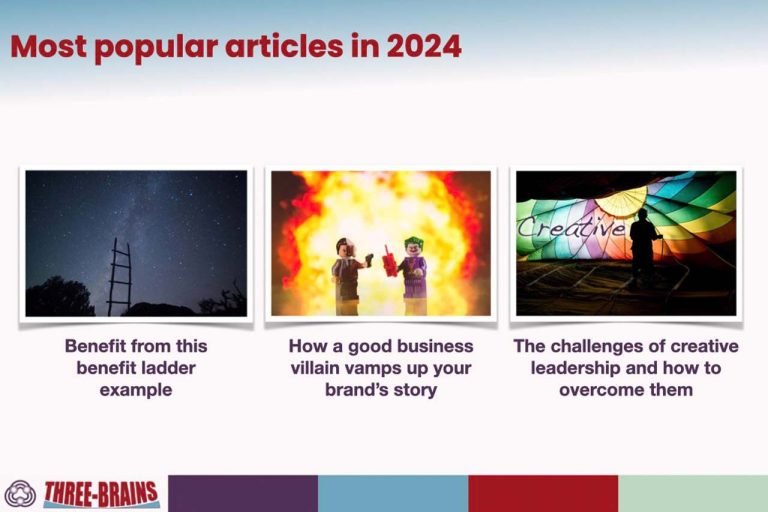
Benefit from this benefit ladder example
Our run-away winner in terms of traffic was our benefit ladder article from January 2024.
It started by explaining how this key marketing planning tool helps you build your brand positioning. The article explained each rung of the ladder, from product features up to emotional benefits. Then, it showed how each rung interacts with the other.
It’s no surprise that this gathered lots of interest, given that “benefit” is such a key marketing word. We even got it into the article title twice.

Marketers know customers look for benefits. We guess our customers were looking for benefits in this article.
However, as in previous years, what seemed to make it stand out was that we included a case study. Many online articles are basically how-to guides. That’s fine. However, adding a case study to show the lessons being used (rather than just saying what they are) seems to make it more interesting for readers.
The case study was on the Sydney Pineapple Pizza Company. Previous articles, e.g. on the marketing mix and on the market attractiveness model, also used this business as a case study. So there’s a chance it could be that people just like reading about pizza.
What lesson from this could you use this year?
This article’s key lesson was that building your benefits has to work on multiple levels. The benefit ladder helps you work out how these levels interact and which benefits to use where.
Advertising gurus will tell you the emotional benefit is most important. And generally, it is. In advertising.
The emotional part of your brain, which covers areas like sensory inputs and learning / memory, decides pretty quickly if an advert is worth paying attention to. (though it’s our instinctive brains which notice the advert in the first place).

However, at other parts of the customer journey, the other benefits will be more relevant.
For example, when you’re hungry and ordering off the website, you want to know how long the delivery will take (a functional benefit). At that point, you don’t care about how it’ll make you feel (an emotional benefit). That’s more for when you’re first deciding which pizza shop to order from (if you’re new to the area) or remembering why you like the pizza from that place (because it makes you feel happy).
It would be a good exercise to kick off your brand thinking for the year ahead to review your benefits and benefit ladder, especially if you haven’t done so recently.
How a good business villain vamps up your brand’s story
The second of our most popular lessons from 2024 was February’s Business Villain article. It shared some thought-provoking ideas about storytelling.
First, it used imagery and ideas from popular culture. This loosely links to one of the pillars of challenger brand thinking and likely helped this article grab some attention.
In this case, we used an Unsplash image from Mehdi MeSSrro of Lego versions of Two Face and Joker. Both are well-known villains.

Then, a fan-fiction parody short scene between Bruce Wayne and Alfred where it turns out no villainy had happened in Gotham that day. So Bruce goes off to play golf. The point? No villainy means no story.
But beyond that pop cultural opening lay an even more intriguing idea. The article deliberately looked at the opposite of a “normal” idea by looking at the villain rather than the hero. Looking at opposites opens up intriguing and inspiring creative thinking opportunities.
The original idea for this came from Robert McKee’s Story, one of the best-known guides on how to write screenplays (using story, obviously).
McKee suggests that to strengthen your story, you should spend as much time building your villain’s story as building your hero’s story.
Why? Because the villain creates the drama for the hero. And stories need drama to draw the reader in. Drama comes from the hero’s problem, which in most stories is driven by conflict with the villain. The villain gets in the way of what the hero really wants. The level of conflict could be :-
- extra-personal – a broad organisational or societal challenge.
- personal – someone close to the hero getting in their way.
- inner – a worry or fear the hero has.
What lesson from this could you use this year?
While pop culture links are always fun, the stronger idea here is the concept of looking at opposites.
When it comes to creativity, it’s easy to go with your instincts and choose what’s obvious. But if everyone does that, you all end up with the same ideas. No one stands out. No one challenges the status quo. Everything becomes predictable and looks and sounds the same.
That’s not what creativity is about.

That’s not to say you should be negative about everything. Looking at opposites isn’t about being contrarian. It’s more about understanding both sides of a story. As all good debaters know, you strengthen your own story when you better understand the opposite point of view.
So, put yourself in the shoes of your customer’s “villain”. Their problem or conflict area. This helps you better articulate the issue and position your brand’s value in helping customers overcome it.
Try re-looking at your brand’s story as a useful creative exercise to start the year. Do you truly understand the villain in your story? Maybe it’s big dominant brands price-gouging? Or conservative agencies playing it safe with middling marketing and insipid ideas? Ask yourself how you can challenge the complacency in your category and help customers be the heroes of their own stories.
The challenges of creative leadership and how to overcome them
We wrote a series of articles about leadership in July and August. The one on creative leadership captured the most attention and was the third most popular of our lessons from 2024. It got almost twice as many visits as the articles on marketing and e-Commerce leadership combined.
We think this is because creativity is a particularly tough leadership challenge. People generally understand what marketing and e-Commerce leaders do. Plus, those functions have fairly predictable processes and outputs.

However, many people don’t understand creativity and the unpredictability of the creative process. They fear it. Put up barriers. Tough creative approval processes. Lots of negativity and idea-killing. This wariness of creativity comes at all levels, from the CEO down to the teams working at the company’s coal face.
The article explored key challenges faced by creative leaders :-
- The binary view of operations and creativity – where operations drive routines and processes, and creativity drives speculating and experimenting.
- Creativity isn’t seen as a leadership skill – the view that creativity is “light and fluffy” and shouldn’t be part of the “serious” side of business.
- Leadership politics – the challenge of changing people’s minds that some failure is a necessary result of creativity. That you shouldn’t punish it but use it to come up with better ideas.
The article explored different ideas about how to tackle these creative challenges. For example, education programs on the value of creativity and how to work more collaboratively and constructively. It also covered the role of leadership teams in building a more creative culture and the difference between creative leadership and those who merely steward the current business.
What lesson from this could you use this year?
Given the state of the world, as we enter the New Year, the last of our lessons from 2024 is really more about positivity than about pragmatism.
Creativity has enormous potential to improve people’s lives. For us, that’s the biggest opportunity in the year ahead.
There’s already enough fear and anger, misery and sadness around. You can’t control the horrible effects of wars, climate change and what’s happening in the shit show that is modern politics these days.

However, you can control the impact you have on those around you. On your customers. Your agencies. The people in your business. You can set yourself a goal to be a better creator this year. To put more positive emotions out into the world. Surprise. Delight. Joy. Happiness.
Use your creativity to drive those emotions and make 2025 a better year for all.
Conclusion - Three-Brains most popular lessons from 2024
So there we are. Our most popular lessons from 2024.
Of the 26 articles we shared last year, the one that offered the biggest benefits, by talking about benefits, came out on top. That it was then followed by two creative thinking led articles gives us some hope for the year ahead.
It’s not that our other articles don’t also offer helpful advice. For example, the most popular e-Commerce article was on supply chain management. A very practical how-to article.
But it made us think that our audience appreciates open-mindedness and creativity. That they’re looking to explore ideas and make the world a more creative place. A place where bright ideas not only survive but thrive. Look out for more thought-provoking articles from us as we aim to make 2025 a great year for ideas.
Check out our previous popular article posts from 2023 and 2022 for more creative ideas. Or get in touch to find out how we can help you with ideas that mean business.
Photo Credits
Ladder against night sky : Photo by Mike Lewinski on Unsplash
Two-Face and Joker Lego : Photo by Mehdi MeSSrro on Unsplash
Creative skills multicoloured parachute (adapted) : Photo by Chad Walton on Unsplash
Entering the ring : Photo by Attentie Attentie on Unsplash
Happy woman : Photo by Clay Banks on Unsplash


